
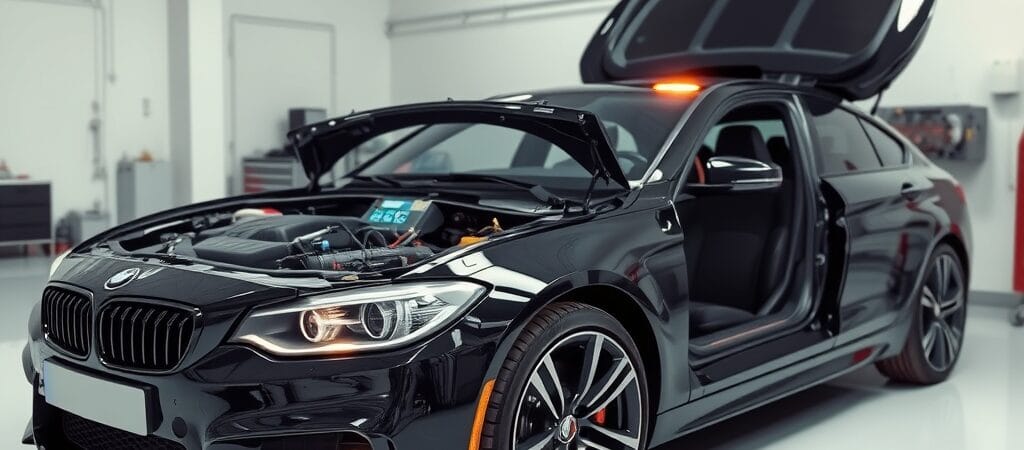
If your car won’t start but the lights still work, the working lights do not prove that the battery or starting system is healthy. Headlights and accessories require much less current than the starter motor, and a weak battery or poor connection may still power them while failing under the much heavier starting load. Diagnosis should first determine whether the engine does not crank, cranks slowly, or cranks normally but does not start, because each condition points toward a different diagnostic path.
Diagnosing the Issue: Car Won’t Start but Lights Work
What This Problem Means
“Car won’t start but the lights work” describes a symptom rather than a specific fault. If the engine does not crank or cranks slowly, possible causes include a weak battery, poor battery or ground connections, starter-circuit faults, starter problems, or an issue preventing starter operation. If the engine cranks at normal speed but does not start, the problem may instead involve fuel delivery, ignition, engine-management inputs, immobilizer/security systems, or mechanical conditions. Identify the type of no-start before testing or replacing components.
Symptoms to Watch For
Aside from the car not starting, you might notice a few key symptoms:
- No crank and no sound: the starter does not appear to operate.
- A single click or repeated clicking: useful evidence, but not proof that the starter itself has failed.
- Slow cranking: may indicate insufficient battery power, excessive resistance in the starting circuit, starter problems, or other conditions.
- Normal cranking but no start: generally shifts diagnosis away from the basic starter circuit toward fuel, ignition, engine-management, security, or mechanical causes.
- Lights dim significantly during the attempt: may provide a clue about battery condition, connections, or high current draw, but requires testing for confirmation.
Possible Causes of Starting Problems
Weak or Discharged Battery
A battery may have enough energy to illuminate dashboard lights or headlights but still be unable to supply the much higher current required during cranking. Battery condition should therefore be evaluated under load or with an appropriate battery test rather than judged solely by whether the lights work.
Faulty Starter Motor
A starter motor or starter-mounted solenoid can cause a no-crank condition, but clicking or lack of cranking does not prove the starter has failed. Battery condition, cable voltage drop, control-circuit operation, grounds, and the signal reaching the starter should be checked before replacement.
Starter-Control or Interlock Problems
Depending on the vehicle, starter operation may depend on an ignition switch or start button, starter relay, park/neutral or clutch interlock, immobilizer/security authorization, control modules, wiring, and other inputs. A failure anywhere in the control path may prevent cranking even when lights and accessories operate normally.
Corroded or Loose Battery Connections
Loose, corroded, damaged, or high-resistance battery terminals, cables, or ground connections can allow low-current accessories to operate while restricting the much higher current required by the starter. Visual inspection is useful, but voltage-drop testing during a starting attempt can reveal resistance that is not obvious visually.
Starter Relay, Solenoid, or Circuit Faults
A starter relay, solenoid, fuse, wiring fault, poor connection, or control-circuit problem can prevent starter operation. Test the relevant circuit according to the vehicle-specific wiring diagram before replacing a relay, solenoid, or starter assembly.
Cranks Normally but Does Not Start
If the starter cranks the engine at a normal speed but the engine does not run, do not focus only on the battery and starter. Diagnosis may need to consider ignition, fuel delivery, engine-speed or position signals, immobilizer/security operation, mechanical condition, and other engine-management inputs. Stored DTCs and live data can help determine which system should be tested next.
Step-by-Step Diagnostic Process
Confirming the Issue
Begin by identifying the exact no-start condition. Does the engine not crank at all, crank slowly, crank normally without starting, or start and then stall? Listen for clicks or unusual noises and observe how the dashboard lights behave during the starting attempt. This first distinction determines which diagnostic path makes sense.
Inspecting Obvious Causes
Inspect the battery terminals and accessible battery, starter, and ground connections for looseness, corrosion, damage, or overheating. Confirm that the transmission is fully in Park or Neutral where applicable, or that the clutch is fully depressed on vehicles that require it. Also note any security or immobilizer warning. Do not assume a visually clean connection has low resistance; electrical testing may still be required.
Checking for Trouble Codes
Scan the vehicle for stored and pending DTCs when appropriate, particularly if the engine cranks normally but does not start or if security, powertrain, or network faults are suspected. Some starting-related faults may be stored outside the engine control module, so a scan tool with access to additional vehicle modules can be useful. A DTC identifies a detected condition or circuit problem; it does not by itself prove that a particular component has failed.
Testing Essential Systems
Check battery state of charge and condition using an appropriate test method. Open-circuit voltage can provide useful information, but a single voltage reading does not establish whether the battery can supply adequate cranking current. Observe battery voltage during the starting attempt or perform an appropriate load/conductance test where applicable. If the engine does not crank, test the starter’s power, ground, and control circuits using vehicle-specific specifications. Voltage-drop testing across the positive and ground sides of the high-current circuit can help identify excessive resistance. Do not replace the starter merely because voltage is present at one terminal; confirm that the required power, ground, and control conditions are present and that the starter itself has failed.
If the Engine Cranks Normally
If cranking speed appears normal, move beyond the starter circuit. Review relevant DTCs and live data and determine whether the engine has the required ignition, fuel delivery, engine-speed/position information, and mechanical conditions to start. Follow vehicle-specific procedures rather than replacing fuel, ignition, or sensor components based only on the no-start symptom.
Repair Options After Diagnosis
If the Battery is the Issue
If diagnostics confirm that the battery is discharged or has failed, determine whether charging is appropriate or replacement is required. Also inspect and test the charging system and connections when the reason for the battery condition is unclear. Our guide on how to diagnose a car that won’t start provides a broader diagnostic approach. After repair, verify that the battery and starting system operate correctly.
Repairing a Confirmed Starter-Circuit Fault
If testing confirms that the starter motor or solenoid has failed, repair or replace the affected component according to the vehicle-specific procedure. If testing instead identifies excessive cable resistance, a poor ground, damaged wiring, relay fault, or another control-circuit problem, repair that confirmed cause rather than replacing the starter unnecessarily.
Repairing Confirmed Control or Engine-System Faults
If diagnosis confirms a starter-control fault, repair the affected switch, relay, interlock, wiring, module input, or other component according to the vehicle-specific procedure. For an engine that cranks normally but does not start, repair only the fuel, ignition, sensor, security, mechanical, or other engine-system fault supported by diagnostic evidence.
Safety Measures for Diagnosis and Repair
Electrical Safety Precautions
Avoid shorting battery terminals or unfused high-current starter connections with tools or test leads. Battery cables and starter circuits can carry very high current. Disconnecting the battery may be required for certain repairs, but follow the vehicle manufacturer’s procedure because disconnecting power can affect stored settings, security systems, module memory, or required initialization procedures. Never disconnect the battery simply as a substitute for proper electrical testing.
Avoiding Hazards from Moving Parts
Keep hands, clothing, tools, and test leads clear of belts, pulleys, fans, and other components that may move when the engine cranks or starts unexpectedly. Make sure the transmission is in Park or Neutral as specified, apply the parking brake, and use appropriate procedures whenever another person operates the ignition during testing.
Frequently Asked Questions
What does it mean when my car won’t start but the lights work?
It means some electrical power is available, but it does not prove that the battery or starting system is healthy. First determine whether the engine does not crank, cranks slowly, or cranks normally without starting. That distinction helps identify which systems need testing.
What are common causes of starting issues?
For a no-crank or slow-crank condition, possible causes include a weak battery, high-resistance battery or ground connections, starter-circuit faults, starter problems, or starter-control/interlock issues. If the engine cranks normally but does not start, possible causes shift toward fuel, ignition, engine-management, security, or mechanical problems.
Can working lights rule out a bad battery?
No. Lights and accessories require much less current than the starter motor. A weak battery or high-resistance connection may still operate the lights while failing when the starter demands substantially more current.
How can I diagnose why my car won’t start?
First identify whether the problem is no-crank, slow-crank, or crank-no-start. Inspect the battery and connections, evaluate battery condition under starting load, and test the starter power, ground, and control circuits when appropriate. If the engine cranks normally, use DTCs, live data, and targeted fuel, ignition, sensor, security, or mechanical testing to continue the diagnosis.
What should I check first if my car won’t start?
Start by observing exactly what happens when you attempt to start the vehicle. Determine whether the engine cranks and how fast it cranks, then inspect battery connections and note any clicking, dimming lights, security warnings, or other symptoms. This prevents testing the wrong system.
Final Checks
Working lights do not rule out a weak battery, poor electrical connection, or starting-system problem. Begin by classifying the complaint as no-crank, slow-crank, or crank-no-start. Inspect simple causes, test the battery and relevant circuits under the conditions in which the fault occurs, use DTCs and live data when appropriate, and repair only the fault supported by diagnostic evidence. After repair, verify that the engine cranks and starts normally and that the original symptoms do not return.